
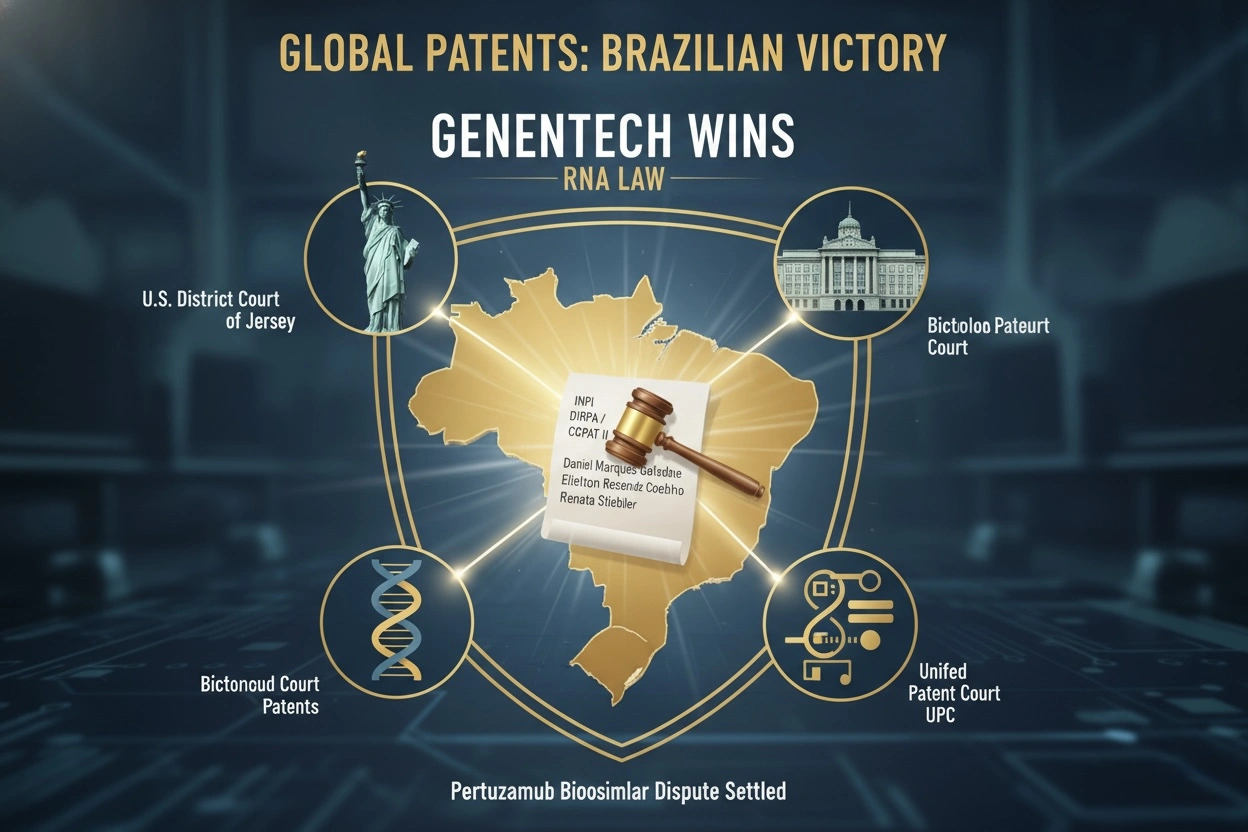
Brazil delivered Genentech’s most consequential merits win, an inflection point that likely shaped the global resolution and showcased the strategic value of a strong local litigation team on the ground.
Roche’s Genentech, Organon and China’s Henlius have reached a wide‑ranging settlement that resolves major litigation over a pertuzumab biosimilar in multiple key jurisdictions: the United States (District of New Jersey), the Unified Patent Court (UPC), the Netherlands (The Hague District Court), and Brazil, where the dispute had progressed the furthest. Public visibility of the settlement first emerged from filings in the U.S. District Court for the District of New Jersey. Two developments stand out as likely drivers of the settlement dynamics: (i) a Brazilian validity decision described as the most significant win Genentech had secured in the campaign; and (ii) an evidentiary order in the UPC that strengthened Genentech’s procedural position. In practice, global life‑sciences disputes often turn on the jurisdiction that moves first on the merits; here, Brazil appears to have played that role, with Genentech’s Brazilian counsel helping convert technical record‑building into settlement leverage.
While parallel proceedings were underway in several forums, Brazil appears to have been the jurisdiction where the case was most advanced. A technical opinion supporting Genentech’s position was issued within Brazil’s National Institute of Industrial Property (INPI) by DIRPA / CGPAT II / DIPAT IX. The opinion was led by division head Daniel Marques Golodne, with examiners Elielton Rezende Coelho and Renata Stiebler. Against that technical backdrop, Genentech’s Brazil team, represented by RNA Law, was able to litigate from a posture of momentum. In a multi‑jurisdiction strategy, an advanced merits outcome, particularly on validity, can materially change leverage, timelines and risk appetite. Here, the Brazilian decision is expressly noted as Genentech’s most significant win and would have been central to any global settlement calculus.
On the UPC side, the matter involved both the Court of Appeal and the Brussels Local Division. The Court of Appeal panel was Panel 3, composed of Presiding Judge Ulrike Voss ("Voß" in German), Judge‑rapporteur Nathalie Sabotier, and Judge Bart van den Broek. The Brussels Local Division panel was chaired by Presiding Judge (and judge‑rapporteur) Samuel Granata, alongside Judge Petri Rinkinen (Helsinki, Finland) and Judge Rute Lopes (Lisbon, Portugal). An evidentiary order issued within the UPC framework is highlighted as another key procedural win for Genentech, often the type of interim measure that can accelerate resolution by clarifying what evidence will (or will not) be available at trial.
In the Netherlands, proceedings were brought before the District Court of The Hague under the "Accelerated Regime in Patent Matters" (VRO), a fast‑track framework used for high‑stakes patent disputes. The specialized division referenced for the VRO includes Presiding Judge Edger Brinkman (also a UPC judge and recently featured in an ip fray article dated January 28, 2026), Judge Margot Kokke, Judge Marije Knijff, and Judge Marjolein Visser (all of whom are also UPC judges). The available record suggests the parties’ counsel in The Hague was presumably the same as in the UPC proceedings.
In the United States, the case sat in the U.S. District Court for the District of New Jersey, before U.S. District Judge Claire C. Cecchi. That docket is where the settlement first became publicly discoverable, underscoring how U.S. procedural transparency frequently provides the earliest public signal of broader global resolutions.
Technical opinion (INPI - DIRPA / CGPAT II / DIPAT IX): division head Daniel Marques Golodne; examiners Elielton Rezende Coelho and Renata Stiebler.
Genentech’s counsel in Brazil: RNA Law’s Rob Rodrigues, Brenno Telles and Tatiana Alves, an IP litigation team known for handling complex, multi‑forum disputes and coordinating closely with international counsel.
Counsel for Organon: Lefosse’s Rafael Salomão and Ricardo Nunes.
Court of Appeal panel (Panel 3): Presiding Judge Ulrike Voss; Judge‑rapporteur Nathalie Sabotier; Judge Bart van den Broek.
Brussels Local Division panel: Presiding Judge (and judge‑rapporteur) Samuel Granata; Judge Petri Rinkinen; Judge Rute Lopes.
UPC counsel for Genentech: Freshfields’s Rutger Kleemans; Allard van Duijn (not listed on the firm’s website); Nerissa Teeuwen.
UPC counsel for Organon: Pinsent Masons’s Judith Krens; Vural Ergisi; Alasdhair McDonald; Emily Flood.
VRO specialized division: Presiding Judge Edger Brinkman; Judge Margot Kokke; Judge Marije Knijff; Judge Marjolein Visser.
Judge: U.S. District Judge Claire C. Cecchi.
Counsel for Hoffman‑La Roche and Genentech: Robinson Miller’s Keith J. Miller, Michael J. Gesualdo and Bradley A. Suiters; and Groombridge, Wu, Baughman & Stone’s Eric Alan Stone and Naz E. Wehrli.
Counsel for Henlius and Organon: Stone Conroy’s Rebekah Conroy.
First, this resolution illustrates how a single advanced merits decision, especially on validity, can reset negotiating dynamics across an entire global dispute. Second, interim procedural wins (such as UPC evidentiary orders) can be settlement catalysts by reducing uncertainty about what each side can prove and when. Third, forum selection and speed matter: Brazil’s comparatively advanced posture and The Hague’s VRO fast‑track demonstrate how timelines can drive business risk and therefore settlement timing. Fourth, the matter highlights a practical point that is easy to underestimate until a settlement is on the table: well‑aligned local counsel can materially influence global outcomes by moving early on the record, landing decisive rulings, and keeping strategy consistent across venues. Finally, for companies planning biosimilar launches or lifecycle strategies, disciplined coordination across counsel teams and jurisdictions remains indispensable, particularly as the UPC adds a powerful new layer to European enforcement.
This analysis is based on an article by Florian Mueller, published January 31, 2026, summarizing the settlement and identifying the judges, panels and counsel involved across the relevant jurisdictions.

This section gives quick answers to the most common questions about this insight. What changed, why it matters, and the practical next steps. If your situation needs tailored advice, contact the RNA Law team.
Q1: Which jurisdictions were covered by the settlement?
A1: The settlement resolved disputes in the United States (District of New Jersey), the Unified Patent Court (UPC), the Netherlands (The Hague District Court), and Brazil.
Q2: Why was Brazil described as pivotal in the global resolution?
A2: Brazil was the most advanced on the merits and included a validity decision described as Genentech’s most significant win in the campaign, which likely influenced global leverage.
Q3: What was the role of INPI in the Brazilian proceedings?
A3: A technical opinion supporting Genentech’s position was issued within INPI (DIRPA / CGPAT II / DIPAT IX), providing technical backdrop for the litigation posture.
Q4: What UPC development is highlighted as a procedural win?
A4: An evidentiary order within the UPC framework is highlighted as strengthening Genentech’s procedural position by clarifying what evidence would be available at trial.
Q5: What is the VRO referenced in the Netherlands proceedings?
A5: The VRO is the “Accelerated Regime in Patent Matters,” a fast-track framework used by The Hague District Court for high-stakes patent disputes.
Q6: Where did the settlement first become publicly visible?
A6: Public visibility first emerged from filings in the U.S. District Court for the District of New Jersey.


